Practice portal › Laws of Motion › Friction: Blocks, Belts and Inclines
Asked in JEE Main 12th April 2nd Shift 2019 · The least force, and the best angle to pull
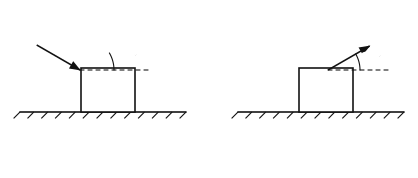
Idea: the horizontal component F cos 30° is the same in both cases. Only the normal force differs, and it differs by 2F sin 30° between pushing down and pulling up.
Case (A), pushed down at 30°:
N_A=mg+F sin 30°=50+10=60 N, f_A=0.2×60=12 N.
Case (B), pulled up at 30°:
N_B=mg-F sin 30°=50-10=40 N, f_B=0.2×40=8 N.
The driving term F cos 30° cancels in the difference, so
a_B-a_A=(f_A-f_B)/m=(12-8)/5=0.8 m s⁻².
In closed form, a_B-a_A=(2μ F sin 30°)/m=(2(0.2)(20)(0.5))/5=0.8 m s⁻².
This is the physics behind pulling a suitcase rather than pushing it: same effort forward, less weight on the wheels.
Reading this solution needs no sign-in. You only sign in to practise against the clock and keep your progress.
Practise this with a timer