Practice portal › Laws of Motion › Friction: Blocks, Belts and Inclines
Asked in JEE Main 2018 · Friction on a level surface
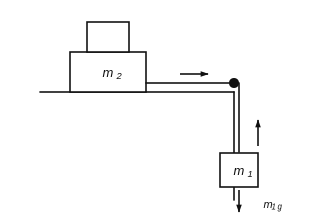
Idea: the system stops when friction under m₂ can hold back the whole hanging weight. Work out the mass that requires, then read the options.
For the system to stay at rest the tension must be m₁g=50 N, and friction must match it:
μ(m₂+m)g≥ m₁g
0.15(10+m)(10)≥50
1.5(10+m)≥50
10+m≥(100)/3=33.3, so m≥23.3 kg.
That exact value is not among the options. Of those offered, 10.3 and 18.3 are both below 23.3 and would not stop the motion; 27.3 and 43.3 both would. The smallest that works is 27.3 kg.
Reading the question as 'which of these masses is the least that stops it' is what the official key does, and it is the only reading under which any option is correct.
Reading this solution needs no sign-in. You only sign in to practise against the clock and keep your progress.
Practise this with a timer