Practice portal › Laws of Motion › Friction: Blocks, Belts and Inclines
Asked in JEE Main 2015 · Friction on belts and accelerating surfaces
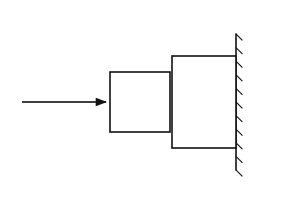
Idea: take the two blocks together. The wall is the only thing outside them that can push or rub vertically, so its friction must hold up both.
The applied force F is horizontal, and the weights are vertical. For the pair A+B in vertical equilibrium:
f_wall=W_A+W_B=20+100=120 N, upward.
The friction between A and B is internal to this system and cancels out; the coefficients 0.1 and 0.15 only tell you how large F must be for this to be possible, not what the friction actually is.
This is the key point about static friction: it is not μ N in general. μ N is only a ceiling, and the actual value is whatever equilibrium requires — here, 120 N.
Reading this solution needs no sign-in. You only sign in to practise against the clock and keep your progress.
Practise this with a timer