Practice portal › Ray Optics and Optical Instruments › Refraction through a Prism
Asked in GUJCET 2026 · Deviation and minimum deviation
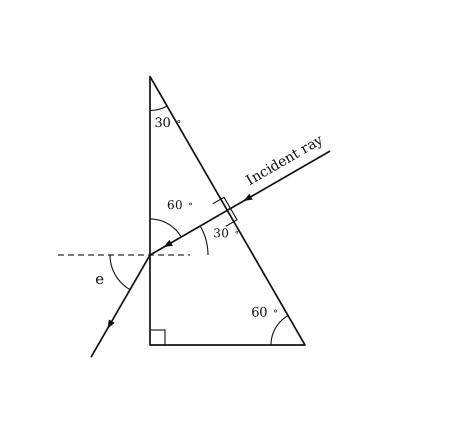
Given: a right-angled prism of refractive index √3 in air. The figure marks the right angle at the bottom-left vertex and 60° at the bottom-right, so the apex angle is 180°-90°-60°=30°.
Idea: the incident ray meets the slanting face along its normal, so it enters without bending; all the refraction happens at the vertical face.
Inside the glass the ray still runs along the normal of the slanting face, and the vertical face's normal is turned from it by the apex angle. So the angle of incidence there is r=30°.
Check that the ray can get out: sin C=1/(√3)=0.577 gives C=35.3°, and 30°<C, so there is no total internal reflection.
Snell's law at the vertical face: √3 sin 30°=1×sin e
sin e=√3×1/2=(√3)/2
e=60°
Reading this solution needs no sign-in. You only sign in to practise against the clock and keep your progress.
Practise this with a timer