Practice portal › Current Electricity › Combination of Resistors
Asked in GUJCET 2025 · Series and parallel combinations
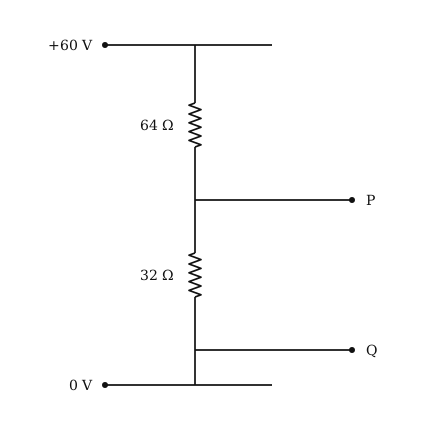
Given: a +60 V rail and a 0 V rail with 64 Ω and 32 Ω in series between them. P is tapped off between the two resistors and Q below the 32 Ω resistor, at the bottom rail.
Idea: P and Q are open terminals, so no current is drawn from them. The supply therefore drives one single loop through the two resistors in series, and V_PQ is just the drop across the 32 Ω resistor.
Total resistance: 64 + 32 = 96 Ω.
Current: I = (60)/(96) = 0.625 A.
V_PQ = I×32 = 0.625×32 = 20 V.
As a check, the 64 Ω resistor takes the other 40 V, and 40 + 20 = 60 V, the whole supply.
So the potential difference between P and Q is 20 V.
Reading this solution needs no sign-in. You only sign in to practise against the clock and keep your progress.
Practise this with a timer