Practice portal › Semiconductor Electronics › Semiconductor Diode and Diode Circuits

If each diode has a forward bias resistance of 25 Ω in the below circuit, which of the following option is correct? [Figure: three parallel branches, each a diode and 125 Ω: top branch D₁ pointing right (current I₄), middle branch D₂ pointing left (current I₃), lower branch D₃ pointing right (current I₂). They are fed by a 5 V cell in series with 25 Ω; the total current is I₁ and the cell drives current rightwards through the branches.]

Asked in JEE Main 10th April 2nd Shift 2023 · Circuits with diodes
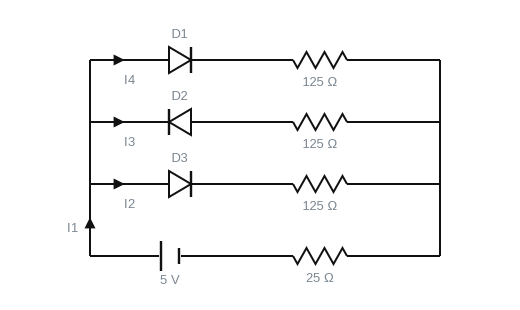
Figure: Circuits with diodes
Answer: (3) (I₁)/(I₂)=2

Step-by-step solution

D₁ and D₃ are forward biased; D₂ is reverse biased, so I₃=0.

Each conducting branch: 25+125=150 Ω. Two in parallel: 75 Ω.

Total: 75+25=100 Ω, I₁=5/(100)=0.05 A.

I₂=I₄=0.025 A, so (I₁)/(I₂)=2.

Why the other options are wrong

More Semiconductor Diode and Diode Circuits questionsAll Semiconductor Diode and Diode Circuits questions →

Reading this solution needs no sign-in. You only sign in to practise against the clock and keep your progress.

Practise this with a timer