Practice portal › Oscillations › Oscillations due to a Spring

[Figure: (A) a block of mass m on a frictionless floor with a block of mass 2m fixed on top of it, joined by a spring of constant k to a wall on each side; (B) a block of mass m on a frictionless floor, joined by a spring of constant k to the left wall and a spring of constant 2k to the right wall.] In figure (A) a mass 2m is fixed on a mass m which is attached to two springs each of constant k. In figure (B) a mass m is attached to two springs of constants k and 2k. The masses in (A) and (B) are each displaced horizontally through x and released. The time periods T₁ and T₂ of (A) and (B) satisfy

Asked in JEE Main 25th July 1st Shift 2022 · Spring combinations
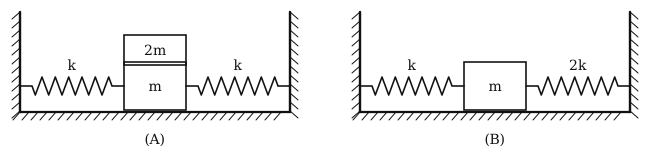
Figure: Spring combinations
Answer: (1) (T₁)/(T₂)=3/(√2)

Step-by-step solution

In (A) the two springs act in parallel, k_A=2k, and the oscillating mass is m+2m=3m: T₁=2π√(3m)/(2k).

In (B) the springs are again in parallel, k_B=k+2k=3k, with mass m: T₂=2π√m/(3k).

(T₁)/(T₂)=√(3m)/(2k)×(3k)/m=√9/2=3/(√2).

Why the other options are wrong

More Oscillations due to a Spring questionsAll Oscillations due to a Spring questions →

Reading this solution needs no sign-in. You only sign in to practise against the clock and keep your progress.

Practise this with a timer