Practice portal › Mechanical Properties of Fluids › Capillary Rise and Angle of Contact
Asked in JEE Main 2014 · Drops in equilibrium
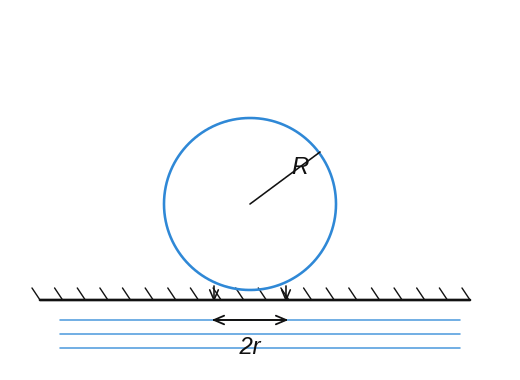
Given: a bubble of radius R sitting on the floor over a contact circle of radius r, with r R.
Idea: buoyancy lifts the bubble while surface tension along the contact circle holds it down, and detachment is the moment these balance.
Surface tension pulls along the liquid surface at the contact line; its vertical part per unit length is T sin θ, where θ is the angle the sphere's surface makes with the vertical there, and for a sphere resting on a plane with r R, sin θ=r/R.
Holding force =2π rTr/R=(2π r²T)/R, and buoyancy =4/3π R³ρ_wg.
Setting them equal, r²=(2ρ_wgR⁴)/(3T).
r=R²√(2ρ_wg)/(3T).
Reading this solution needs no sign-in. You only sign in to practise against the clock and keep your progress.
Practise this with a timer