Practice portal › Laws of Motion › Friction: Blocks, Belts and Inclines
Asked in JEE Main 27th June 1st Shift 2022 · Friction between stacked blocks
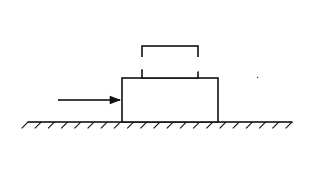
Idea: friction between the blocks is the only thing accelerating the upper one, so it sets a ceiling on the shared acceleration. Turn that ceiling into a ceiling on F.
Upper block. The surfaces press together with N=mg, so the most friction available is
fₘₐₓ=μ mg=0.5×2×9.8=9.8 N.
That friction is all that drives the 2 kg block, so
aₘₐₓ=(fₘₐₓ)/m=(9.8)/2=4.9 m s⁻².
Note this is just μ g — the mass cancels.
Whole system. The table is smooth, so F alone accelerates M+m=10 kg:
Fₘₐₓ=(M+m)aₘₐₓ=10×4.9=49 N.
Push harder than that and the lower block slides out from under the upper one, which can never exceed μ g.
Reading this solution needs no sign-in. You only sign in to practise against the clock and keep your progress.
Practise this with a timer