Practice portal › Electric Potential and Capacitance › Capacitance and Dielectrics
Asked in JEE Main 24th Jan 2nd Shift 2026 · Compound and non-uniform dielectrics
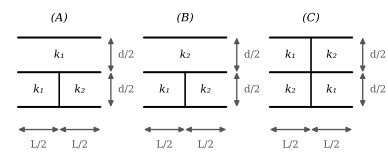
Split each capacitor into a left and a right half by area; within each half the two layers sit one above the other, so each half is a series pair. Write c=(ε₀A)/d, so one quarter block of dielectric k (area A/2, thickness d/2) has capacitance kc.
Two such blocks in series give (kₐk_b)/(kₐ+k_b)c; write h=(k₁k₂)/(k₁+k₂).
(A): left half is k₁ over k₁, giving (k₁)/2c; right half is k₁ over k₂, giving hc. So C_A=((k₁)/2+h)c.
(B): left half is k₂ over k₁, giving hc; right half is k₂ over k₂, giving (k₂)/2c. So C_B=((k₂)/2+h)c.
(C): both halves are one k₁ over one k₂, so C_C=2hc.
C_A-C_B=(k₁-k₂)/2c>0; C_A-C_C=((k₁)/2-h)c=(k₁(k₁-k₂))/(2(k₁+k₂))c>0; C_C-C_B=(h-(k₂)/2)c=(k₂(k₁-k₂))/(2(k₁+k₂))c>0.
Hence C_A>C_C>C_B.
Reading this solution needs no sign-in. You only sign in to practise against the clock and keep your progress.
Practise this with a timer