Practice portal › Current Electricity › Kirchhoff's Laws and Circuit Analysis

In the given circuit the cells have zero internal resistance. The currents (in amperes) passing through resistance R₁ and R₂ respectively, are [Figure: a top wire T joins the top ends of R₁=20 Ω, R₂=20 Ω and a wire down the left side. Bottom wire: from the bottom of the left wire, a 10 V cell (positive terminal to the right) to the bottom of R₁ (node M), then a second 10 V cell (positive terminal to the left, toward M) to the bottom of R₂ (node N).]

Asked in JEE Main 10th Jan 1st Shift 2019 · Kirchhoff's laws in networks
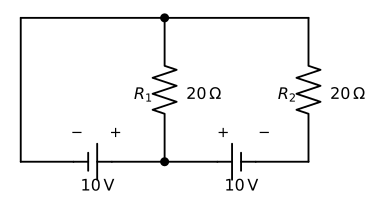
Figure: Kirchhoff's laws in networks
Answer: (4) 0.5, 0

Step-by-step solution

The left wire makes the bottom-left end the same node as the top wire T.

The first cell has its positive side at M: V_M-V_T=10 V, so R₁ carries (10)/(20)=0.5 A.

The second cell has its positive side at M: V_N=V_M-10=V_T.

R₂ has no potential difference, so its current is 0.

Currents: 0.5 A and 0.

Why the other options are wrong

More Kirchhoff's Laws and Circuit Analysis questionsAll Kirchhoff's Laws and Circuit Analysis questions →

Reading this solution needs no sign-in. You only sign in to practise against the clock and keep your progress.

Practise this with a timer