Practice portal › Current Electricity › Kirchhoff's Laws and Circuit Analysis

[Figure: a ladder with three 1 Ω rungs. Top rail from left: a 2 V cell, first rung node, a 2 V cell, second rung node, a 2 V cell, then to the third rung at the right end. Bottom rail from left: a 2 V cell, first rung node, a 2 V cell, second rung node, a 2 V cell, then to the third rung. The left ends of the two rails are joined by a wire. All six cells have the same orientation, positive terminal toward the left.] In the above circuit the current in each resistance is

Asked in JEE Main 2017 · Kirchhoff's laws in networks
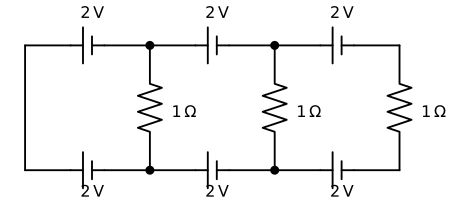
Figure: Kirchhoff's laws in networks
Answer: (4) 0 A

Step-by-step solution

Take the joined left end as 0 V.

Each cell has its positive terminal on the left, so moving right across a cell the potential falls by 2 V.

Top and bottom rails fall together: both ends of the first rung are at -2 V, of the second at -4 V and of the third at -6 V.

Every 1 Ω resistor has zero potential difference, so the current in each is 0 A.

Why the other options are wrong

More Kirchhoff's Laws and Circuit Analysis questionsAll Kirchhoff's Laws and Circuit Analysis questions →

Reading this solution needs no sign-in. You only sign in to practise against the clock and keep your progress.

Practise this with a timer