Practice portal › Ray Optics and Optical Instruments › Refraction and Total Internal Reflection
Asked in GSEB Board July 2018 · Total internal reflection and optical fibres
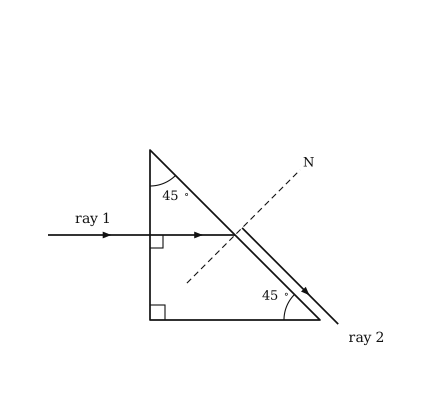
Given: a right-angled prism whose other two angles are 45°. Ray 1 strikes the vertical face along its normal, and ray 2 leaves grazing along the sloping face.
Idea: a ray that comes out grazing the surface has been refracted through 90°, and that happens only when it meets the surface exactly at the critical angle.
Ray 1 enters without bending, so inside the glass it is still travelling horizontally.
The sloping face is tilted at 45°, so its normal is 45° from that horizontal ray: the angle of incidence inside is 45°.
Snell's law at the sloping face with the emergent ray grazing, so r=90°: n sin 45°=1×sin 90°
n=1/(sin 45°)=√2
So 45° is the critical angle of this glass, which is what makes 45° prisms such convenient reflectors.
Reading this solution needs no sign-in. You only sign in to practise against the clock and keep your progress.
Practise this with a timer