Practice portal › Ray Optics and Optical Instruments › Lenses
Asked in GUJCET 2014 · Combinations and silvered lenses
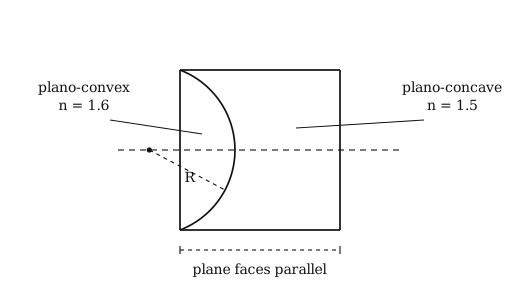
Given: plano-convex lens of index 1.6, plano-concave lens of index 1.5, common curved surface of radius R, and plane outer faces.
Idea: two thin lenses in contact add their powers, 1/F=1/(f₁)+1/(f₂), and each focal length comes from the lens maker's formula 1/f=(n-1)(1/(R₁)-1/(R₂)).
Plano-convex, plane face first: R₁=∞, R₂=-R, so 1/(f₁)=(1.6-1)(0+1/R)=(0.6)/R.
Plano-concave, the same curved surface first: R₁=-R, R₂=∞, so 1/(f₂)=(1.5-1)(-1/R-0)=-(0.5)/R.
Adding: 1/F=(0.6-0.5)/R=(0.1)/R.
So F=R/(0.1), that is 10R — only the difference of the two refractive indices survives, which is why the pair is such a weak lens.
Reading this solution needs no sign-in. You only sign in to practise against the clock and keep your progress.
Practise this with a timer