Practice portal › Electric Potential and Capacitance › Capacitance and Dielectrics
| Capacitor | Area | Separation |
|---|---|---|
| C_1 | A | d |
| C_2 | 2A | d |
| C_3 | A | 2d |
Asked in RS Academy GUJCET booklet · Capacitance of a conductor and a capacitor
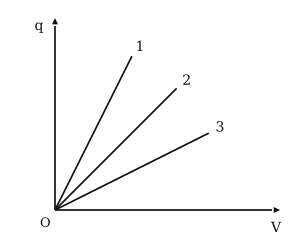
Given: C₁ has (A, d), C₂ has (2A, d), C₃ has (A, 2d).
Idea: C = (ε₀A)/d; write C₀ = (ε₀A)/d.
Then C₁ = C₀, C₂ = 2C₀ and C₃ = (C₀)/2.
On a q–V graph (q vertical, V horizontal) each capacitor is a straight line through the origin with slope q/V = C.
So the steepest line, 1, is the largest capacitance C₂; line 2 is C₁; the least steep line, 3, is C₃.
Answer: 1 → C₂, 2 → C₁, 3 → C₃.
Reading this solution needs no sign-in. You only sign in to practise against the clock and keep your progress.
Practise this with a timer