Practice portal › Electric Charge and Properties › Electric Flux and Gauss's Law
Asked in RS Academy GUJCET booklet · Gauss's law and enclosed charge
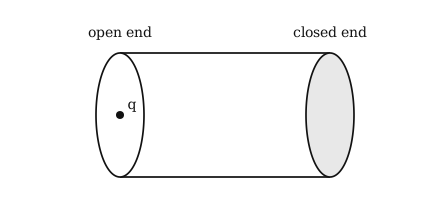
Idea: close the cylinder with an imaginary flat lid across the open end. The charge then sits on the lid, in its plane.
A charge lying on a flat part of a closed surface has exactly half of its field lines going into the enclosed side, so the flux through the closed surface is 1/2×q/(ε₀).
Through the imaginary lid itself the flux is zero: at every point of the lid the field of q lies along the lid, parallel to its surface.
So all of that half passes through the real cylinder - its curved wall and its closed base.
Total flux through the cylinder =q/(2ε₀), whatever the length and radius of the cylinder.
Reading this solution needs no sign-in. You only sign in to practise against the clock and keep your progress.
Practise this with a timer