Practice portal › Semiconductor Electronics › p-n Junction Formation
Asked in Re-NEET 2026 · Depletion region and barrier potential
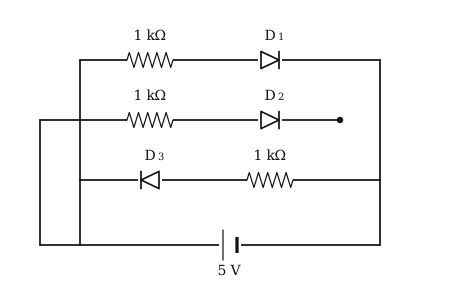
Idea: the depletion region is as wide as it needs to be to support the potential across the junction, so the bias decides the width.
D₁ has the battery driving it in the easy direction, so it is forward biased and its region is the narrowest: W₁ is least.
D₃ is connected the other way round, so it is reverse biased and carries more potential than the built-in barrier alone: W₃ is greatest.
D₂ sits in a branch left open, so no bias reaches it at all. It keeps its built-in width, which lies between the other two.
Hence W₃>W₂>W₁.
Reading this solution needs no sign-in. You only sign in to practise against the clock and keep your progress.
Practise this with a timer