Practice portal › Rotational Motion › Centre of Mass

A frictionless circular wire of unit radius is fixed on the horizontal plane. Two point particles of unit mass start moving simultaneously from point A (θ=π/2) with identical uniform angular speeds in opposite directions, and meet again at point B (θ=-π/2). During this time, which of the following figures schematically represent the magnitude of the total linear momentum P of the system, as a function of θ? (The four graphs are shown in the figure; each runs from θ=π/2 on the left to θ=-π/2 on the right.)

Asked in Re-NEET 2026 · Discrete systems and motion of the centre of mass
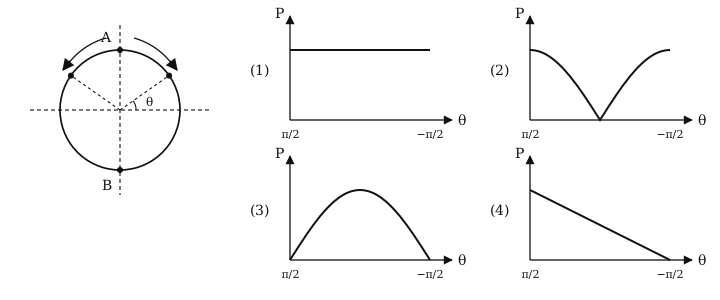
Figure: Discrete systems and motion of the centre of mass
Answer: (3) Graph (3): P rises from zero to a maximum midway and falls back to zero

Step-by-step solution

Take θ as the angle of particle 1 from the horizontal diameter; by symmetry particle 2 is at π-θ.

Velocities: ⃗v₁=v(sin θ,-cos θ) and ⃗v₂=v(-sin θ,-cos θ).

The components across AB cancel and those along it add: P=2mv cos θ.

P=0 at θ=±π/2 and P=2mv at θ=0: a single hump, graph (3).

Why the other options are wrong

More Centre of Mass questionsAll Centre of Mass questions →

Reading this solution needs no sign-in. You only sign in to practise against the clock and keep your progress.

Practise this with a timer