Practice portal › Moving Charges and Magnetism › Ampere's Circuital Law, Solenoid and Toroid
Asked in NEET 2021 · Thick wires and cables
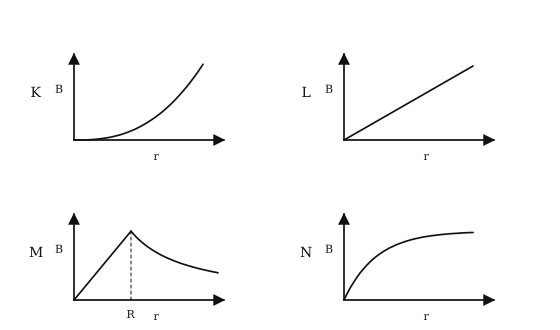
Idea: the same two-region argument as for any solid wire, from ∮⃗B· d⃗l=μ₀I_enc.
Inside, r<R: I_enc=I(r²)/(R²), giving B=(μ₀Ir)/(2π R²)∝ r.
On the axis B=0; at the surface it reaches (μ₀I)/(2π R).
Outside, r>R: B=(μ₀I)/(2π r)∝1/r.
So the graph is a straight line up to a peak at r=R, then a 1/r tail.
That is graph (3).
Reading this solution needs no sign-in. You only sign in to practise against the clock and keep your progress.
Practise this with a timer