Practice portal › Electric Potential and Capacitance › Capacitance and Dielectrics
Asked in NEET-II 2016 · Compound and non-uniform dielectrics
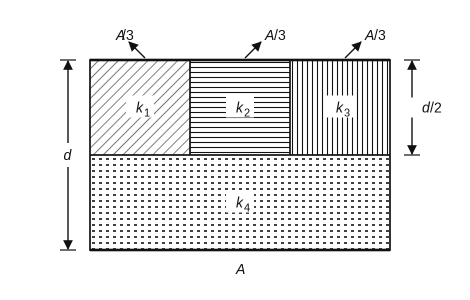
Upper layer (thickness d/2): three blocks side by side, each of area A/3, so they add in parallel.
Cᵤₚ=(ε₀(A/3)(k₁+k₂+k₃))/(d/2)=(2ε₀A(k₁+k₂+k₃))/(3d).
Lower layer (thickness d/2, area A): C₄=(2ε₀Ak₄)/d.
The two layers are in series: 1/C=(3d)/(2ε₀A(k₁+k₂+k₃))+d/(2ε₀Ak₄).
A single dielectric: C=(kε₀A)/d, so 1/k=3/(2(k₁+k₂+k₃))+1/(2k₄).
Multiply by 2: 2/k=3/(k₁+k₂+k₃)+1/(k₄).
Reading this solution needs no sign-in. You only sign in to practise against the clock and keep your progress.
Practise this with a timer