Practice portal › Alternating Current › AC Through R, L and C
Asked in NEET 2012 · Behaviour of R, L and C separately
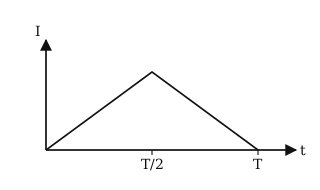
For an inductor V=L(dI)/(dt), so the voltage follows the slope of the current graph,
not its value.
On the rising half the slope is a positive constant, so the voltage holds one constant value.
At the peak the slope changes sign abruptly.
On the falling half the slope is a negative constant of the same size, so the voltage holds the
opposite constant value.
A triangular current therefore gives a square voltage waveform, switching between two levels with
no zero section in between - the current is never steady, so the voltage is never zero.
Reading this solution needs no sign-in. You only sign in to practise against the clock and keep your progress.
Practise this with a timer