Practice portal › Work, Energy and Power › Inelastic Collisions and Coefficient of Restitution
Asked in AIEEE 2009 · Perfectly inelastic collisions
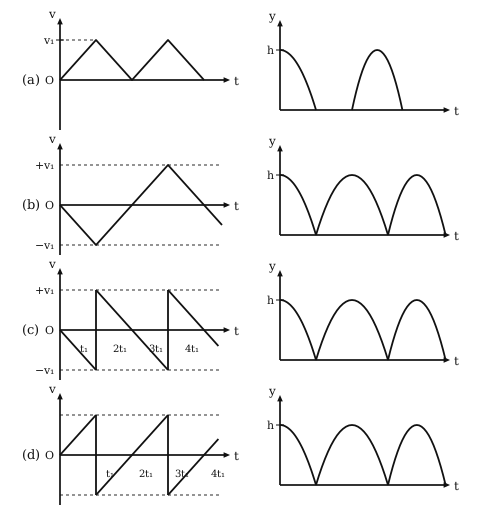
Take upward as positive, as the y-graphs do. While falling the velocity is negative and grows linearly: a straight line from 0 down to -v₁ at t₁.
At the elastic bounce it flips instantly to +v₁, then decreases linearly through 0 (top of the bounce at 2t₁) to -v₁ at 3t₁, and so on: a sawtooth with vertical jumps upward.
The height is a parabola from h to 0, then repeated identical arches back to h. This is graph (c).
Reading this solution needs no sign-in. You only sign in to practise against the clock and keep your progress.
Practise this with a timer