Practice portal › Thermal Properties of Matter › Junction and Interface Temperature
Asked in JEE Main 22nd Jan 1st Shift 2026 · Junction temperature
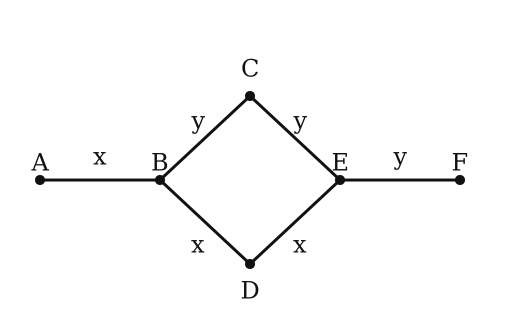
Given: all rods have the same length and area, and Kₓ=3K_y. Let one rod of material y have resistance R; then one rod of material x has R/3.
AB is one x rod, so R_AB=R/3; EF is one y rod, so R_EF=R.
Between B and E the upper branch is two y rods, 2R, and the lower branch two x rods, (2R)/3; in parallel R_BE=(2R×(2R)/3)/(2R+(2R)/3)=R/2.
Total R_AF=R/3+R/2+R=(11R)/6, so the current is I=(100-40)/(11R/6)=(360)/(11R).
T_B=100-I×R/3=100-(120)/(11)=89.1 °C and T_E=40+I× R=40+(360)/(11)=72.7 °C.
So the junctions sit at about 89 °C and 73 °C.
Reading this solution needs no sign-in. You only sign in to practise against the clock and keep your progress.
Practise this with a timer