Practice portal › Thermodynamics › Work Done in a Thermodynamic Process

A piston of mass M is hung from a massless spring whose restoring force law goes as F=-kx³, where k is the spring constant of appropriate dimension. The piston separates the vertical chamber into two parts, the bottom part being filled with n moles of an ideal gas. External work is done on the gas isothermally, at constant temperature T, with the help of a heating filament of negligible volume mounted in the lower part of the chamber, so that the piston goes up from a height L₀ to L₁. The total energy delivered by the filament is (assume the spring is at its natural length before heating)

Asked in JEE Main 3rd April 1st Shift 2025 · Work from a Stated P-V Law
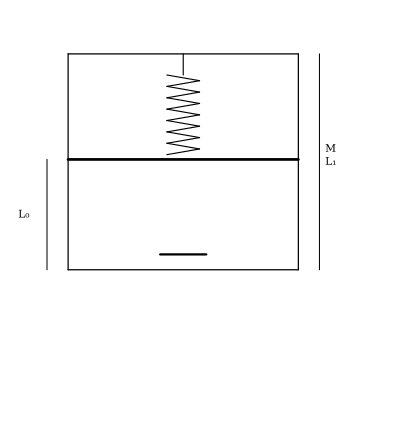
Figure: Work from a Stated P-V Law
Answer: (4) nRT ln (L₁)/(L₀)+Mg(L₁-L₀)+k/4(L₁⁴-L₀⁴)

Step-by-step solution

The filament has to supply three things at once.

Gas, isothermal: Δ U=0, so the heat equals the work the gas does,

W_gas=nRT ln (V₁)/(V₀)=nRT ln (L₁)/(L₀) since the area is fixed.

Piston lifted: Mg(L₁-L₀).

Spring stretched against F=-kx³: ∫_L₀^L₁kx³dx=k/4(L₁⁴-L₀⁴).

Total =nRT ln (L₁)/(L₀)+Mg(L₁-L₀)+k/4(L₁⁴-L₀⁴).

Why the other options are wrong

More Work Done in a Thermodynamic Process questionsAll Work Done in a Thermodynamic Process questions →

Reading this solution needs no sign-in. You only sign in to practise against the clock and keep your progress.

Practise this with a timer