Practice portal › Moving Charges and Magnetism › Motion of a Charge in a Magnetic Field

A charged particle of mass m and charge q moving under the influence of uniform electric field Eı̂ and a uniform magnetic field Bk̂ follows a trajectory from point P to Q as shown in figure. The velocities at P and Q are respectively, vı̂ and -2vȷ̂. Then which of the following statements (A, B, C, D) are the correct? (Trajectory shown is schematic and not to scale)
(A) E = 3/4((mv²)/(qa))
(B) Rate of work done by the electric field at P is 3/4((mv³)/a)
(C) Rate of work done by both the fields at Q is zero.
(D) The difference between the magnitude of angular momentum of the particle at P and Q is 2mav.

Asked in JEE Main 9th Jan 1st Shift 2020 · Helical paths and field regions
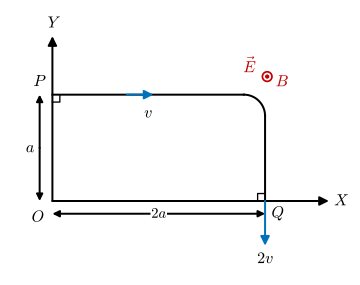
Figure: Helical paths and field regions
Answer: (2) (A), (B), (C)

Step-by-step solution

Only E⃗ does work: qE(2a) = 1/2m(4v² - v²), so E = (3mv²)/(4qa). A true.

At P, power = qEv = 3/4(mv³)/a. B true.

At Q, velocity is along -y, perpendicular to E⃗; magnetic power is always zero. C true.

|L_P| = m v a, |L_Q| = m(2v)(2a) = 4mav; difference 3mav. D false.

Why the other options are wrong

More Motion of a Charge in a Magnetic Field questionsAll Motion of a Charge in a Magnetic Field questions →

Reading this solution needs no sign-in. You only sign in to practise against the clock and keep your progress.

Practise this with a timer