Practice portal › Laws of Motion › Friction: Blocks, Belts and Inclines
Asked in JEE Main 24th Jan 1st Shift 2026 · Friction between stacked blocks
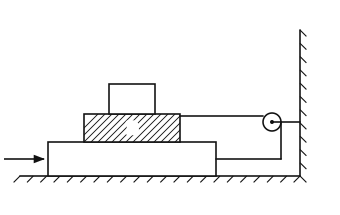
Idea: work out the normal force at each rubbing surface, and notice that the string over the wall pulley makes C pay for the B-C surface twice.
The three normal forces. Each surface carries everything above it:
A on B: N₁=4g=40 N, so f₁=0.5×40=20 N.
B on C: N₂=(4+6)g=100 N, so f₂=0.5×100=50 N.
C on the floor: N₃=(4+6+8)g=180 N, so f₃=0.5×180=90 N.
Why f₂ counts twice. B and C are joined by a string that runs over a pulley fixed to the wall, so dragging C to the left hauls B to the right. F must overcome the B-C friction directly on C, and it must also supply the string tension that drags B against that same friction.
Taking B first, at constant speed:
T=f₁+f₂=20+50=70 N.
Then for C:
F=T+f₂+f₃=70+50+90
F=210 N.
A note on f₁. That term belongs in B's equation only if A is kept from riding along with B. With A simply loose on top, it would be carried along once everything is at constant speed, no kinetic friction would act there, and the force would be 190 N. The printed answer includes it.
Reading this solution needs no sign-in. You only sign in to practise against the clock and keep your progress.
Practise this with a timer