Practice portal › Laws of Motion › Equilibrium of Concurrent Forces
Asked in JEE Main 2nd April 2nd Shift 2025 · Strings and ropes in equilibrium
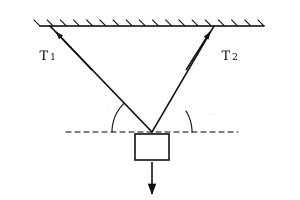
Idea: the two strings are perpendicular to each other (60°+30°=90°), so the force triangle is right-angled and the tensions come out cleanly.
Let T₁ make 60° with the horizontal on the left and T₂ make 30° on the right.
Horizontal balance:
T₁ cos 60°=T₂ cos 30°
(T₁)/2=(√3)/2T₂, so T₁=√3 T₂.
Vertical balance:
T₁ sin 60°+T₂ sin 30°=mg=10
√3T₂·(√3)/2+T₂·1/2=10
(3T₂)/2+(T₂)/2=2T₂=10, so T₂=5 N and T₁=5√3 N.
Check: √T₁²+T₂²=√75+25=10 N, which is the weight — exactly what perpendicular strings must give.
Reading this solution needs no sign-in. You only sign in to practise against the clock and keep your progress.
Practise this with a timer