Practice portal › Laws of Motion › Newton's Laws and Free-Body Diagrams
Asked in JEE Main 26th Feb 2nd Shift 2021 · Springs and spring constants
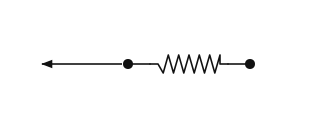
Idea: the spring is the only thing touching A, so the spring force has magnitude Ma; by Newton's third law it acts on B with the same magnitude in the opposite sense, and that sense turns out to oppose F.
Mass A. Its one and only horizontal force is the spring's, so
F_spring=Ma.
Which way does the spring pull? F drives B away from A, so the spring stretches. A stretched spring pulls its two ends towards each other: it drags A along after B, and it holds B back. The separation still grows, because B accelerates harder than A does — that is what 'moving away from B' records.
Mass B. The applied force and the spring's pull act in opposite directions:
F-F_spring=Ma_B
a_B=(F-Ma)/M.
Consistency check: the gap only opens if a_B>a, which needs F>2Ma — so the stem is quietly telling us the applied force is more than twice Ma.
Reading this solution needs no sign-in. You only sign in to practise against the clock and keep your progress.
Practise this with a timer