Practice portal › Laws of Motion › Blocks on Inclines and Wedges
Asked in JEE Main 1st Sept 2nd Shift 2021 · Blocks sliding on a fixed incline
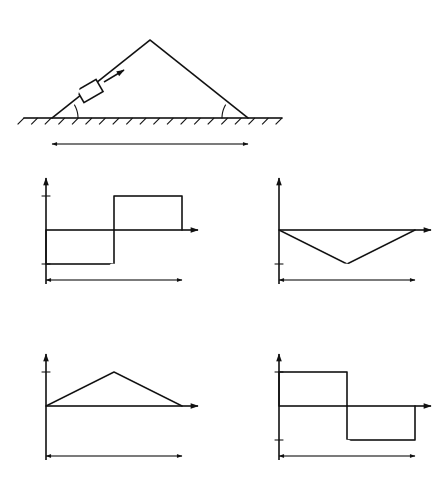
Idea: constant velocity means zero net force at every instant, so the applied force exactly cancels the component of gravity along the surface — and that component reverses at the summit.
Up the first face. Gravity pulls the object back down the slope with mg sin θ, so the applied force must act forward, up the slope:
F=+mg sin θ=+2 N, constant, because θ does not change along a straight face.
Down the second face. Gravity now pulls the object along its direction of travel, so to hold the speed constant the applied force must point backwards:
F=-mg sin θ=-2 N, again constant.
The hill is symmetric, so the two faces have the same θ and the two rectangles have the same height, each spanning half of D.
That is a +2 N block followed by a -2 N block.
The tapering graphs are wrong for a plain geometric reason: a straight slope has one fixed angle, so mg sin θ cannot grow and shrink along it.
Reading this solution needs no sign-in. You only sign in to practise against the clock and keep your progress.
Practise this with a timer