Practice portal › Laws of Motion › Pulleys, Strings and Connected Bodies
Asked in JEE Main 26th July 1st Shift 2022 · Tension in connected bodies
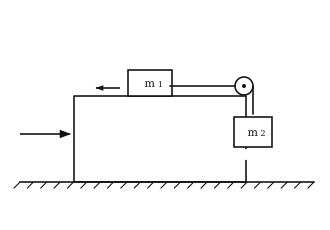
Idea: the cart accelerates right with some A; the string makes m₁ slide backwards relative to the cart by exactly as much as m₂ rises, so m₁ and m₂ do not share one acceleration.
Start with the block that has the simplest equation, the hanging m₂, vertically:
T-m₂g=m₂(2)
T=20(10+2)=240 N.
The string is inextensible, so if m₂ rises at 2 m s⁻² then m₁ moves at 2 m s⁻² backwards relative to the cart. In the ground frame m₁'s acceleration is therefore A-2, and the only horizontal force on it is the tension:
T=m₁(A-2)
240=10(A-2), so A=26 m/s².
Now take the whole system horizontally. F is the only external horizontal force, and the three masses have horizontal accelerations A, A-2 and A:
F=MA+m₁(A-2)+m₂A
F=100(26)+10(24)+20(26)=2600+240+520
F=3360 N.
Treating all 130 kg as moving at A gives 3380 N — option (b), and the reason the relative motion has to be tracked.
Reading this solution needs no sign-in. You only sign in to practise against the clock and keep your progress.
Practise this with a timer