Practice portal › Motion in a Straight Line › Sketching and Matching Motion Graphs
Asked in JEE Main 4th Sept 1st Shift 2020 · Sketching and matching motion graphs
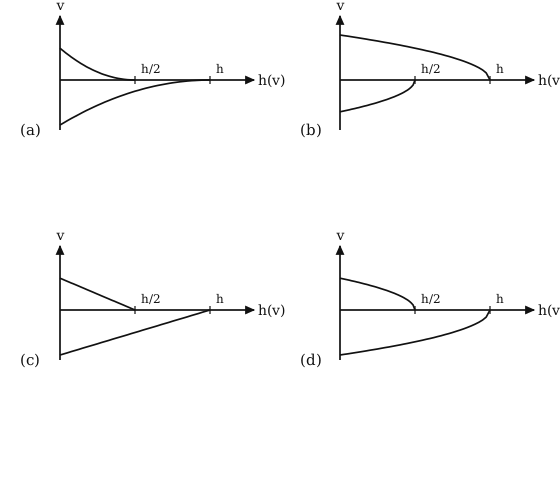
Take upward as positive. Falling from h: v = -√2g(h - y), negative and growing in size as the height y shrinks to zero.
In the v–h plane that is a parabola (y = h - v²/2g) running from (h, 0) down to (0, -√2gh).
After the bounce the ball rises with a smaller positive speed: v = +√2g(h/2 - y), another parabola from (0, +√gh) up to (h/2, 0).
Two curved branches, the lower one (negative v) reaching h, the upper one (positive v) ending at h/2: graph (d).
Reading this solution needs no sign-in. You only sign in to practise against the clock and keep your progress.
Practise this with a timer