Practice portal › Gravitation › Newton's Law of Gravitation
Asked in JEE Main 1st Sept 2nd Shift 2021 (also asked in 2014) · Mutual gravitation and binary systems
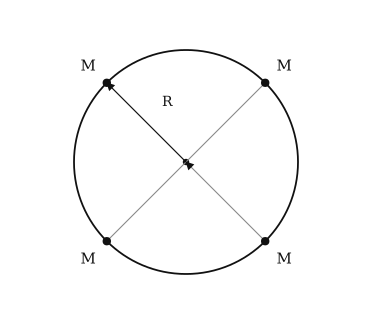
The four particles sit at the corners of a square inscribed in the circle, so each side is √2R and each diagonal is 2R.
The two neighbours pull with (GM²)/(2R²) each along the sides, and their resultant along the diagonal is (√2GM²)/(2R²).
The opposite particle adds (GM²)/((2R)²)=(GM²)/(4R²) along that same line, so F=(GM²(2√2+1))/(4R²).
Setting F=(MV²)/R gives V=1/2√(GM(2√2+1))/R.
Reading this solution needs no sign-in. You only sign in to practise against the clock and keep your progress.
Practise this with a timer