Practice portal › Electric Potential and Capacitance › Capacitance and Dielectrics

In the figure a capacitor is formed by placing a compound dielectric between the plates of a parallel plate capacitor. The expression for the capacity of the said capacitor will be (area of each plate =A) [the gap is filled by three slabs stacked one behind the other across the gap — regions C₁, C₂ and C₃ of dielectric constants K, 3K and 5K and thicknesses d, 2d and 3d respectively, so the three act in series]

Asked in JEE Main 27th July 1st Shift 2021 · Compound and non-uniform dielectrics
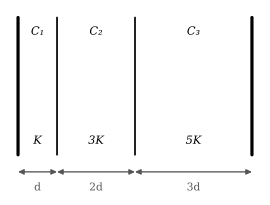
Figure: Compound and non-uniform dielectrics
Answer: (4) (15)/(34)(Kε₀A)/d

Step-by-step solution

Slabs stacked one behind the other across the gap carry the same charge, so they combine in series.

C₁=(Kε₀A)/d, C₂=(3Kε₀A)/(2d), C₃=(5Kε₀A)/(3d).

1/C=d/(Kε₀A)(1+2/3+3/5)=d/(Kε₀A)·(15+10+9)/(15)=(34)/(15)d/(Kε₀A).

C=(15)/(34)(Kε₀A)/d, which is smaller than any one of the three, as a series combination must be.

Why the other options are wrong

More Capacitance and Dielectrics questionsAll Capacitance and Dielectrics questions →

Reading this solution needs no sign-in. You only sign in to practise against the clock and keep your progress.

Practise this with a timer