Practice portal › Electric Potential and Capacitance › Electrostatic Potential Energy
Asked in JEE Main 5th Sept 1st Shift 2020 · Energy conservation and closest approach
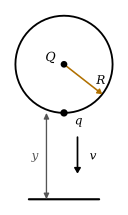
After detachment the remaining sphere carries Q, and the piece starts at the surface, at distance R from the centre, ending at distance R+y.
Outside a uniformly charged sphere the potential is that of a point charge, so the electrical work on the piece is W_E=q[V(R)-V(R+y)]=kqQ[1/R-1/(R+y)]=(kqQ y)/(R(R+y)).
Gravity does W_g=mgy.
Energy conservation from rest: 1/2mv²=mgy+(kqQ y)/(R(R+y)).
v²=2gy+(2kqQ y)/(mR(R+y))=2y[(qQ)/(4πε₀ R(R+y)m)+g].
Reading this solution needs no sign-in. You only sign in to practise against the clock and keep your progress.
Practise this with a timer