Practice portal › Electric Potential and Capacitance › Electric Potential
Asked in JEE Main 22nd Jan 2nd Shift 2026 · Potential of point charges
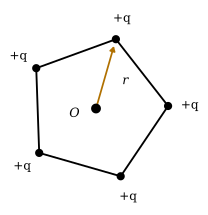
Potential is a scalar, so the five contributions simply add: V=5×1/(4πε₀)q/r=(5q)/(4πε₀ r).
The field is a vector. The five equal fields at O have the same magnitude (kq)/(r²) and are spaced 72° apart.
Vectors of equal length spread uniformly around a full turn sum to zero, so ⃗E=0.
This is the standard result for any regular polygon with identical charges at every vertex: V eq0 but ⃗E=0 at the centre.
Reading this solution needs no sign-in. You only sign in to practise against the clock and keep your progress.
Practise this with a timer