Practice portal › Electric Charge and Properties › Electric Field of Point Charges
Asked in JEE Main 8th April 2nd Shift 2024 · Field of discrete charges
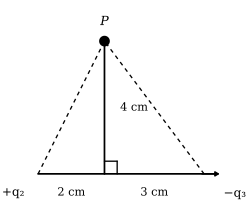
Put the foot of the perpendicular at the origin, P at (0,4), +q₂ at (-2,0) and -q₃ at (3,0), distances in cm.
Distances to P: r₂=√4²+2²=√20 and r₃=√4²+3²=5.
The condition is that the y-components cancel. +q₂ pushes P away, giving a +y component (kq₂)/(r₂²)·4/(r₂); -q₃ pulls P towards it, giving a -y component (kq₃)/(r₃²)·4/(r₃).
Equating: (q₂)/(r₂³)=(q₃)/(r₃³), so |(q₂)/(q₃)|=(r₂³)/(r₃³)=(20√20)/(125)=(40√5)/(125)=(8√5)/(25)=8/(√125).
Comparing with 8/(√25x) gives 25x=125, so x=5.
Reading this solution needs no sign-in. You only sign in to practise against the clock and keep your progress.
Practise this with a timer