Practice portal › Electric Charge and Properties › Electric Field of Point Charges
Asked in JEE Main 8th Jan 1st Shift 2020 · Field of discrete charges
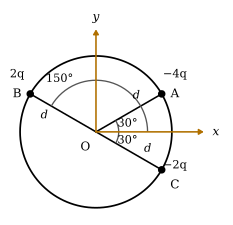
Each charge is at a distance d from O, so each contributes a field of magnitude (k|qᵢ|)/(d²): towards the charge if it is negative, away from it if positive.
A is negative, at 30°: field points towards A, x-component =(k(4q))/(d²)cos 30°=(2√3 kq)/(d²).
C is negative, at -30°: field points towards C, x-component =(k(2q))/(d²)cos 30°=(√3 kq)/(d²).
B is positive, at 150°: field points away from B, i.e. along -30°, x-component =(k(2q))/(d²)cos 30°=(√3 kq)/(d²).
Total Eₓ=(2√3+√3+√3)(kq)/(d²)=(4√3 q)/(4πε₀ d²)=(√3 q)/(πε₀ d²).
Reading this solution needs no sign-in. You only sign in to practise against the clock and keep your progress.
Practise this with a timer