Practice portal › Electric Charge and Properties › Field of Spheres, Shells and Cylinders
Asked in JEE Main 8th April 1st Shift 2023 · Shell and uniform solid sphere
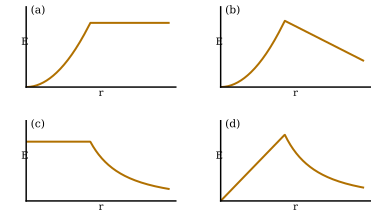
Inside, a Gaussian sphere of radius r<R encloses qᵢₙ=Q(r³)/(R³), so E=(kQr)/(R³) — a straight line through the origin.
At r=R the two expressions meet at the maximum E=(kQ)/(R²).
Outside, the whole charge acts as if at the centre: E=(kQ)/(r²), falling off as 1/(r²).
So the graph rises linearly to a peak at r=R and then decays as an inverse square.
Reading this solution needs no sign-in. You only sign in to practise against the clock and keep your progress.
Practise this with a timer