Practice portal › Electric Potential and Capacitance › Electrostatic Potential Energy
Asked in JEE Main 12th Jan 1st Shift 2019 · Energy conservation and closest approach
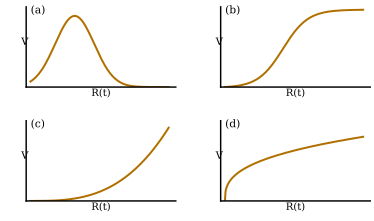
A uniformly charged shell of radius R and total charge Q has self-energy U=(kQ²)/(2R).
As the shell expands, U falls and the lost energy appears as kinetic energy: 1/2MV²=(kQ²)/2(1/(R₀)-1/R).
So V=√(kQ²)/M(1/(R₀)-1/R), which is zero at R=R₀ and increases steeply at first because 1/R changes fastest there.
As R→∞ the bracket tends to 1/(R₀), so V→ V₀=√(kQ²)/(MR₀), a finite saturation speed.
The graph therefore rises sharply from zero and then flattens to a horizontal asymptote.
Reading this solution needs no sign-in. You only sign in to practise against the clock and keep your progress.
Practise this with a timer