Practice portal › Current Electricity › Kirchhoff's Laws and Circuit Analysis

In the circuit, given in the figure currents in different branches and value of one resistor are shown. Then potential at point B with respect to the point A is [Figure: top row of nodes E, D, B from left to right, bottom row A, C, F. E to D: a resistor. D to B: a 2 V battery with its positive terminal toward D. E to A (left side): a resistor carrying 1 A downward from E to A. A to C: a 1 V battery with its positive terminal toward C, current arrow pointing from A to C. D to C: a 2 Ω resistor. C to F: a resistor carrying 2 A from C to F. B to F (right side): a plain wire.]

Asked in JEE Main 5th Sept 2nd Shift 2020 · Kirchhoff's laws in networks
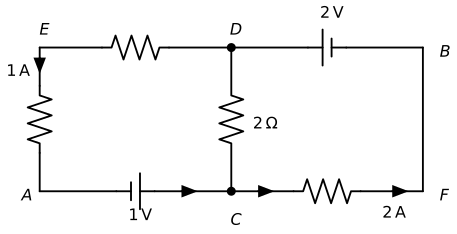
Figure: Kirchhoff's laws in networks
Answer: (4) +1 V

Step-by-step solution

Junction C: 1 A arrives from A and 2 A leaves to F, so 1 A flows from D to C through 2 Ω.

Walk from A to B via C and D.

Across the 1 V battery (negative to positive): V_C-V_A=+1 V.

Up through 2 Ω against the current: V_D-V_C=+1×2=+2 V.

Across the 2 V battery (positive to negative): V_B-V_D=-2 V.

V_B-V_A=1+2-2=+1 V.

Why the other options are wrong

More Kirchhoff's Laws and Circuit Analysis questionsAll Kirchhoff's Laws and Circuit Analysis questions →

Reading this solution needs no sign-in. You only sign in to practise against the clock and keep your progress.

Practise this with a timer