Practice portal › Current Electricity › Resistance and Resistivity
Suppose the drift velocity v_d in a material varied with the applied electric field E as v_d∝√E. Then V-I graph for a wire made of such a material is best given by [Figure: four sketches of V (vertical) against I (horizontal), described in the options.]
Asked in JEE Main Online 2015 · Resistance of a wire and stretching
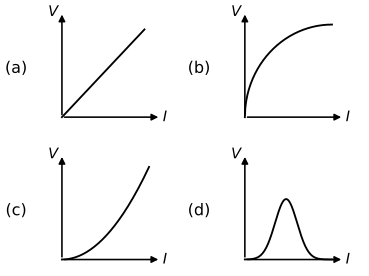
- (1) A straight line through the origin (V∝ I)
- (2) A curve through the origin, rising steeply at first and flattening out (concave down)
- (3) A curve through the origin, starting flat and bending upward ever more steeply (concave up, like V∝ I²)
- (4) A single hump: V rises from zero to a peak and falls back towards zero as I increases
Answer: (3) A curve through the origin, starting flat and bending upward ever more steeply (concave up, like V∝ I²)
Step-by-step solution
I=neAv_d, so I∝ v_d∝√E.
For a uniform wire E=V/L, so I∝√V.
Hence V∝ I²: a parabola through the origin that curves upward.
Why the other options are wrong
- (1) This is ordinary Ohm's law, which needs v_d∝ E.
- (2) This is V∝√I, the inverse of the actual relation.
- (4) No physical relation of this kind produces a peak; this has no basis in the given law.
Reading this solution needs no sign-in. You only sign in to practise against the clock and keep your progress.
Practise this with a timer