Practice portal › Current Electricity › Combination of Resistors

Five equal resistances are connected in a network as shown in figure. The net resistance between the points A and B is [Figure: triangle with vertices D (top), E (bottom left) and C (bottom right); each side DE, DC, EC is a resistor R. A central node O is joined to D by a resistor R and to E by a resistor R. Terminal A is joined to O by a plain wire, and terminal B is joined to C by a plain wire; O has no direct link to C.]

Asked in JEE Main 26th Feb 1st Shift 2021 · Symmetric and complex networks
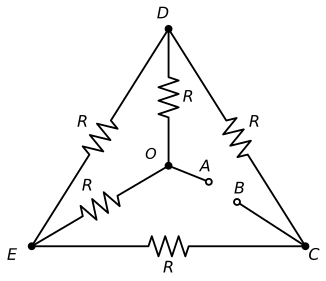
Figure: Symmetric and complex networks
Answer: (1) R

Step-by-step solution

Resistance is needed between O (joined to A) and C (joined to B).

By symmetry, D and E are equivalent: each connects to O by R and to C by R.

So D and E are at the same potential and no current flows in DE; remove it.

O to {D,E}: two R in parallel =R/2. {D,E} to C: two R in parallel =R/2.

R_AB=R/2+R/2=R.

Why the other options are wrong

More Combination of Resistors questionsAll Combination of Resistors questions →

Reading this solution needs no sign-in. You only sign in to practise against the clock and keep your progress.

Practise this with a timer