Practice portal › Current Electricity › Combination of Resistors

The equivalent resistance between A and B is [Figure: a rectangular loop drawn as a 3 by 2 grid. The top-left corner is split into two terminals: A leads into the top side, B leads into the left side. Top side from A: 6 Ω to top-middle node P, then 10 Ω to the top-right corner. Right side: 5 Ω down to right-middle node S, then 7 Ω down to the bottom-right corner. Bottom side from the right: 8 Ω to bottom-middle node V, then 11 Ω to the bottom-left corner. Left side from the bottom: 4 Ω up to left-middle node X, then 8 Ω up to B. A plain vertical wire joins P to V. A plain horizontal wire joins X to S, hopping over the vertical wire without contact.]

Asked in JEE Main 9th April 1st Shift 2024 · Series and parallel combinations
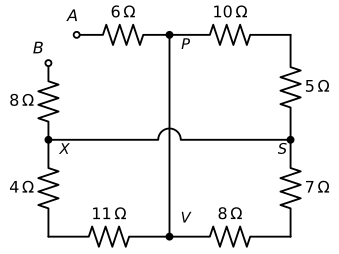
Figure: Series and parallel combinations
Answer: (4) 19 Ω

Step-by-step solution

The vertical wire makes P and V one node; the horizontal wire (not touching it) makes X and S one node.

From A: 6 Ω to node P; from node X: 8 Ω to B.

Between P and S: 10+5=15 Ω, 8+7=15 Ω, and 11+4=15 Ω (via V to X) in parallel, giving 5 Ω.

R_AB=6+5+8=19 Ω

Why the other options are wrong

More Combination of Resistors questionsAll Combination of Resistors questions →

Reading this solution needs no sign-in. You only sign in to practise against the clock and keep your progress.

Practise this with a timer