Practice portal › Semiconductor Electronics › Semiconductor Diode and Diode Circuits
Asked in GUJCET 2025 · Circuits with diodes
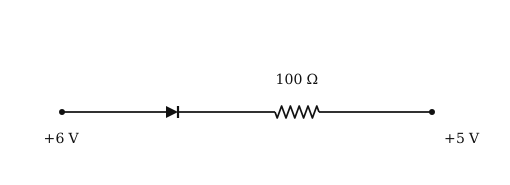
Given: the left terminal is held at +6 V and the right terminal at +5 V, with an ideal diode and a 100 Ω resistor in series between them.
Idea: settle the bias before doing any arithmetic. The triangle (anode) faces the +6 V end and the bar (cathode) faces the +5 V end, and 6 V is the higher potential, so the diode is forward biased and conducts.
An ideal diode has zero forward resistance, so it drops no voltage and the whole difference appears across the resistor.
V_R = 6 - 5 = 1 V
I = (V_R)/R = 1/(100) = 0.01 A = 10 mA
Reading this solution needs no sign-in. You only sign in to practise against the clock and keep your progress.
Practise this with a timer