Practice portal › Ray Optics and Optical Instruments › Refraction through a Prism
Asked in RS Academy GUJCET booklet · Dispersion and scattering
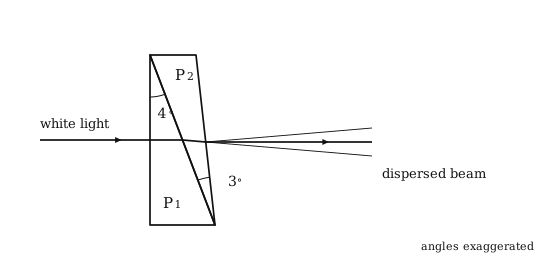
Given: two thin prisms in contact with their refracting angles opposed; A₁ = 4° with n₁ = 1.54, and A₂ = 3°.
Idea: dispersion without deviation means the mean ray carries straight on, so the two prisms must deviate it equally and in opposite senses.
For a thin prism the deviation is δ = A(n-1), independent of the angle of incidence.
Set the two equal: A₁(n₁-1) = A₂(n₂-1).
4°×(1.54-1) = 3°×(n₂-1), so 2.16 = 3(n₂-1) and n₂-1 = 0.72.
n₂ = 1.72: the second prism is of denser glass, so its smaller angle can undo the same deviation while still contributing dispersion of its own.
Reading this solution needs no sign-in. You only sign in to practise against the clock and keep your progress.
Practise this with a timer