Practice portal › Moving Charges and Magnetism › Ampere's Circuital Law, Solenoid and Toroid
Asked in GUJCET 2025 · Thick wires and cables
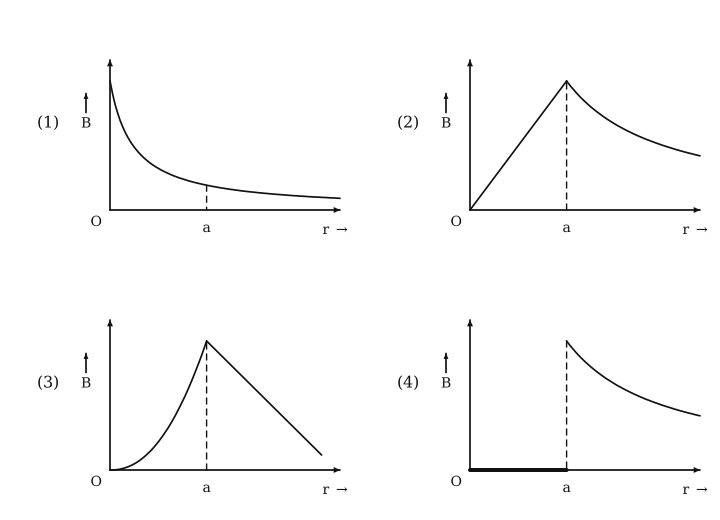
Given: a solid wire of radius a carrying a steady current I spread over its cross-section; B is wanted against the distance r from the axis.
Idea: apply Ampere's circuital law to a circle of radius r about the axis, ∮⃗B· d⃗l=μ₀ I_enc, which gives B(2π r)=μ₀ I_enc.
Inside, r<a: the circle encloses only the fraction (r²)/(a²) of the current, so B=(μ₀ I r)/(2π a²) — a straight line rising from zero at the axis.
Outside, r>a: the whole current is enclosed, so B=(μ₀ I)/(2π r) — a curve falling as 1/r.
The two agree at r=a, where B is greatest, (μ₀ I)/(2π a).
The graph that climbs as a straight line to a peak at r=a and then decays as 1/r is panel (2).
Reading this solution needs no sign-in. You only sign in to practise against the clock and keep your progress.
Practise this with a timer